

Quick Answer
A 504 plan gives a student with a mental health condition accommodations, such as extra time or a reduced workload, so they can access school like their peers. An IEP goes further and provides specialized instruction and services, such as school-based counseling, for students whose condition affects their learning enough to need special education. Many teens with anxiety or depression start with a 504 plan. Teens with more severe or long-lasting needs may qualify for an IEP.
Why School Support Matters for Teen Mental Health
Mental health and school are hard to separate. In the CDC’s most recent national survey, 33% of high school students reported persistent feelings of sadness or hopelessness. Those feelings follow teens into the classroom.
A teen who is struggling may stop turning in work, fall asleep in class, avoid presentations, or stop going altogether. If that last one sounds familiar, see our guide on missing school because of depression and anxiety.
Parents do not have to negotiate all of this informally. Federal law gives students with mental health conditions two formal routes to support.
What Is a 504 Plan?
A 504 plan comes from Section 504 of the Rehabilitation Act of 1973, a civil rights law. It protects students who have “a physical or mental impairment that substantially limits a major life activity.” Learning, concentrating, sleeping, and interacting with others can all count.
Mental health conditions can qualify. The U.S. Department of Education notes that anxiety disorders and ADHD “in many cases would be a mental impairment that substantially limits one or more major life activities.”
A 504 plan does not change what your teen is taught. It changes how they access it, through accommodations in the regular classroom.

What Is an IEP?
An IEP, or Individualized Education Program, comes from the Individuals with Disabilities Education Act (IDEA). It is for students who need special education: instruction and services designed around the individual student.
To qualify, a student must fit one of 13 eligibility categories, and the condition must affect their education enough that they need specialized instruction. For teens with mental health conditions, two categories come up most often:
- Emotional disturbance. Federal regulations define this as a condition shown “over a long period of time and to a marked degree that adversely affects a child’s educational performance.” The listed characteristics include “a general pervasive mood of unhappiness or depression” and “a tendency to develop physical symptoms or fears associated with personal or school problems.” In California, schools may use the term “emotional disability” instead.
- Other health impairment. This category covers conditions, including ADHD, that limit a student’s strength, vitality, or alertness.
An IEP is a detailed written plan with measurable goals, services, and regular reviews.
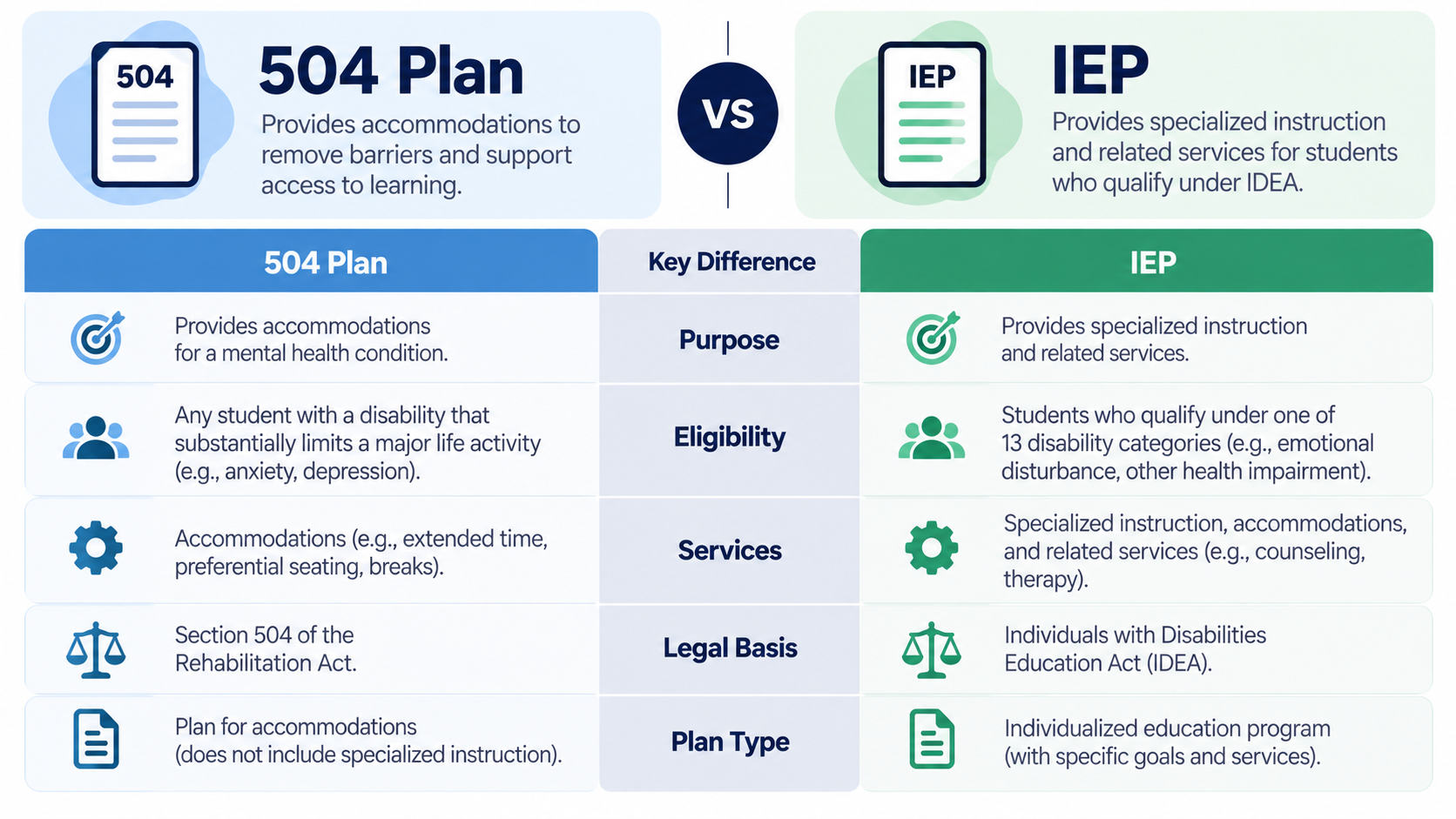
504 Plan vs. IEP: Key Differences
| 504 plan | IEP | |
| Law | Section 504 of the Rehabilitation Act (civil rights law) | Individuals with Disabilities Education Act (special education law) |
| Who qualifies | A student with an impairment that substantially limits a major life activity | A student who fits one of 13 categories and needs specialized instruction |
| What it provides | Accommodations in general education | Specialized instruction, related services such as counseling, and accommodations |
| The document | Usually a short list of accommodations | A detailed plan with annual goals and progress reports |
| Evaluation deadline | No specific federal deadline | Set by law (see the California timeline below) |
| After high school | Section 504 protections continue in college | Ends when the student leaves high school |
Which One Fits a Teen With Anxiety or Depression?
There is no rule that assigns a diagnosis to a plan. What matters is how much the condition affects your teen at school.
A 504 plan is often the right fit when your teen can keep up with the regular curriculum once barriers are removed. For example, a teen with panic attacks who does well with a pass to leave class and extra time on tests.
An IEP may be the right fit when accommodations alone are not enough. For example, a teen whose depression has led to months of failing grades and who needs counseling at school, a smaller setting, or modified instruction.
A diagnosis by itself does not guarantee either plan. The school looks at the effect on your teen’s education. And a teen can move from one to the other as their needs change.
Examples of School Accommodations for Mental Health
Common 504 accommodations:
- Extended time on tests and assignments
- A reduced or adjusted workload during hard periods
- A pass to leave class and see a counselor
- Testing in a quiet, separate room
- Flexibility with attendance for treatment appointments
- Alternatives to oral presentations
- A gradual re-entry schedule after an absence or treatment
Services an IEP can add:
- Counseling at school. In California these are called Educationally Related Mental Health Services, and they can include individual or group counseling and parent counseling.
- Specialized academic instruction
- A behavior support plan
- Placement in a smaller or more supportive setting
In uncommon cases, when an IEP team decides a residential placement is necessary for a student’s education, federal rules say it must be provided “at no cost to the parents.” That is a high bar and a team decision, not something a parent can choose alone.
How to Request a 504 Plan or IEP in California
- Put your request in writing. Email or write to the principal or school counselor. Say that you are requesting an evaluation for a 504 plan, for special education, or for both. Keep a dated copy.
- Share what you have. A letter from your teen’s therapist or psychiatrist describing the diagnosis and how it affects school is helpful. The school makes its own eligibility decision, but outside information strengthens your request.
- Know the special education timeline. In California, the school must give you a proposed assessment plan within 15 calendar days of your referral. You then have at least 15 days to sign. Once you consent, the school has 60 days to complete the assessment and hold the IEP meeting, not counting school breaks longer than five school days.
- Expect less structure for a 504. Section 504 sets no specific federal deadline. Ask your district for its 504 procedures and timelines, and ask who the 504 coordinator is.
- Attend the meeting and ask questions. You are part of the team. If you disagree with the result, you have the right to challenge it.
- Review it regularly. Needs change, especially after a crisis or a course of treatment.
School Support Before, During, and After Treatment
If your teen enters treatment, school support does not pause. It shifts.
- Before. A 504 plan or IEP can reduce pressure while you arrange care.
- During. Teens in residential or day treatment can continue their education. Read more about academic support during therapy and about what a therapeutic day school is.
- After. The return to school is one of the most important moments to have a plan in writing. Ask for a meeting to review or create a 504 plan or IEP before the first day back. Our guide to the transition home after residential treatment covers school reintegration.
Looking further ahead: IEPs do not follow students to college. Section 504 still applies there, but your teen will need to identify themselves to the college’s disability office and may need updated documentation.
How Visions Can Help
When a teen’s mental health is affecting school, the school plan and the treatment plan work best together. At Visions Treatment Centers, education is part of care. Our Therapeutic Day School is accredited by the Western Association of Schools and Colleges, offers a 3:1 student-to-staff ratio, and builds an individualized curriculum so teens can continue their studies during treatment. Our residential programs work with teens’ schools and educators as well.
If school has become the place where your teen’s struggles show up most, Visions can help you understand what is going on and what level of support fits. Call (818) 889-3665 or contact us for a free assessment.
Frequently Asked Questions
Does anxiety qualify for a 504 plan?
It can. The U.S. Department of Education says anxiety disorders in many cases are an impairment that substantially limits a major life activity. The school will look at how anxiety affects your teen at school, not at the diagnosis alone.
Can a student have both a 504 plan and an IEP?
A student with an IEP is already protected by Section 504, so a separate 504 plan is usually not needed. The IEP can include any accommodations a 504 plan would.
Does a mental health diagnosis guarantee an IEP?
No. For an IEP, the condition must fit an eligibility category and affect your teen’s education enough that they need specialized instruction. A teen who does not qualify for an IEP may still qualify for a 504 plan.
Do private schools have to provide a 504 plan?
Only if the school receives federal financial assistance. Section 504 does not apply to private schools that receive no federal funding, although some offer accommodations voluntarily.
Do 504 plans and IEPs carry over to college?
IEPs end after high school. Section 504 and the Americans with Disabilities Act still apply in college, but students must request accommodations themselves, and a high school plan is generally not enough documentation.
Final Takeaway
A 504 plan removes barriers. An IEP adds specialized instruction and services. Which one your teen needs depends on how much their mental health is affecting their education, and that can change over time. Put your request in writing, bring what you know about your teen, and remember that asking for support at school is not a label. It is a way to keep your teen learning while they heal.
This article is general information, not legal advice. Special education rules vary by state and district.
Sources
- U.S. Department of Education. Frequently Asked Questions: Disability Discrimination.
- Code of Federal Regulations, 34 CFR 300.8 (child with a disability) and 34 CFR 300.104 (residential placement).
- California Education Code section 56043 (special education timelines).
- Disability Rights California. Educationally Related Mental Health Services (ERMHS).
- U.S. Department of Education. Students with Disabilities Preparing for Postsecondary Education.
- Centers for Disease Control and Prevention. Youth Risk Behavior Survey: mental health. 2025 data.