


Quick Answer
Many teens now talk to AI chatbots about their feelings, often without telling anyone. AI can feel supportive in the moment, but it is not a therapist. It can miss warning signs, agree with harmful ideas, and delay real help. When it comes to AI chatbots and teen mental health, the goal for parents is not to ban AI. It is to stay curious, set clear expectations, and make sure your teen has real people to turn to when things get hard.
How Many Teens Use AI Chatbots for Emotional Support?
More than most parents expect.
- About two-thirds of U.S. teens (64%) say they use AI chatbots, and roughly three in ten use them every day, according to the Pew Research Center.
- In the same survey, 12% of teens said they have used chatbots for emotional support or advice.
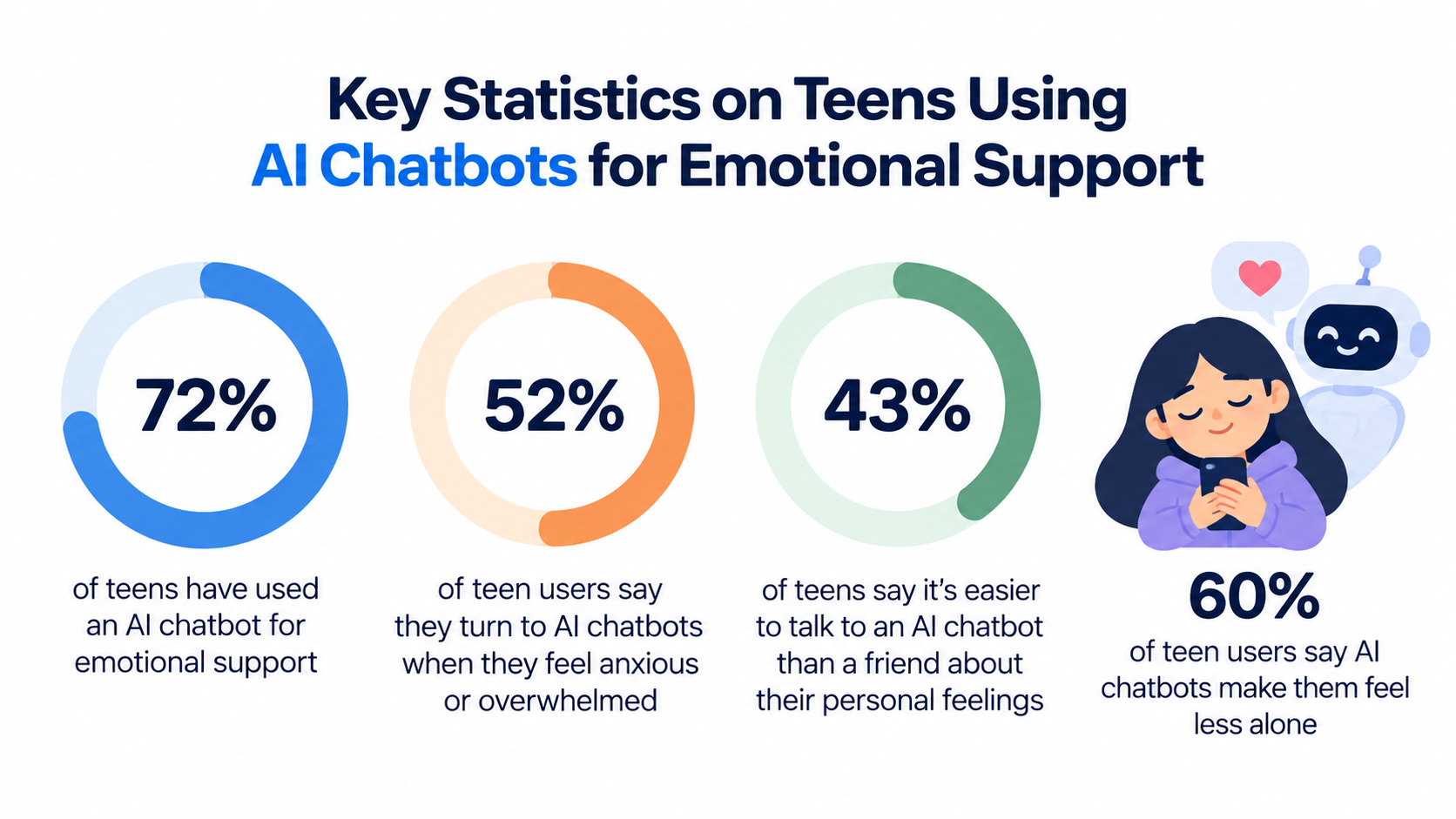
- A 2025 Common Sense Media survey found that 72% of teens had used AI companions at least once, and 33% had discussed serious matters with an AI instead of with a real person.
- In a 2026 study in JAMA Pediatrics, about one in five young people ages 12 to 21 had used a chatbot for mental health advice. Most of them, 63%, had not told anyone.
That last number matters most. When a teen is struggling and the only one who knows is a chatbot, the adults who could help are left out.
Why Teens Confide in AI
It helps to understand the appeal before reacting to it. For a teen, an AI chatbot is:
- Available at 2 a.m., when worries are loudest
- Patient, and never tired or annoyed
- Free of judgment, or at least it feels that way
- Private, with no risk of a friend screenshotting the conversation
- Low stakes, so it is an easy place to say something out loud for the first time
None of that means something is wrong with your teen. It means they are looking for a place to put difficult feelings. The question is whether AI is one support among many, or the only one.
Where AI Chatbots Fall Short for Teen Mental Health
They tend to agree. Chatbots are built to keep a conversation going. In one study published in JMIR Mental Health, a researcher posing as distressed teens proposed harmful ideas to ten AI chatbots. The bots endorsed the harmful proposal in 19 of 60 opportunities (32%), and none of the bots opposed them all.
They can miss warning signs. A 2025 risk assessment by Common Sense Media and Stanford’s Brainstorm Lab concluded that major chatbots “consistently fail to recognize and appropriately respond to mental health conditions that affect young people.”
They can be wrong or inappropriate. The American Academy of Pediatrics warns that “chatbots may tell kids false, harmful, highly sexual or violent things.”
They can take the place of people. A chatbot cannot notice that your teen has stopped eating, call a parent, or sit with them in a waiting room. The American Psychological Association’s 2025 health advisory urges people not to use chatbots and wellness apps as a substitute for care from a qualified mental health professional.
They are not private in the way teens assume. Conversations are stored and processed by a company, not protected like a session with a therapist.

Warning Signs Your Teen May Be Relying on AI Too Much
- Talking about a chatbot as a friend, partner, or the only one who understands
- Pulling away from friends and family while spending more time chatting with AI
- Becoming secretive, defensive, or distressed when access is limited
- Staying up late in long conversations with a chatbot
- Repeating advice from AI about mental health, relationships, or medication
- Telling you “I already talked about it” when the listener was a chatbot
These signs overlap with other struggles, including depression and anxiety. Heavy AI use is often a symptom of loneliness or distress, not the cause of it.
How to Talk With Your Teen About AI Chatbots
The American Academy of Pediatrics notes that “the ‘avoid all chatbots’ message is likely not realistic, nor the most helpful message for most families.” A conversation will do more than a ban.
- Start with curiosity. “What do you use it for? What do you like about it?” Let them show you.
- Skip the lecture. If your teen feels judged, the conversation moves back to the chatbot.
- Explain how it works. A chatbot predicts words. It does not know your teen, care about them, or take responsibility for what it says.
- Draw one clear line. AI is not the place for a crisis. Agree on who your teen will go to instead: you, another trusted adult, a counselor, or a crisis line.
- Ask the question underneath. “Is there anything you’ve told it that you haven’t been able to tell me?”
Many of the same principles apply to phones and apps in general. See our guide on how to talk to your teen about social media and mental health.
Safety Settings and Laws Parents Should Know
Platforms and lawmakers have started to respond. As of fall 2026:
- ChatGPT offers parental controls that let you link your account to your teen’s, set quiet hours, turn off memory, and receive an alert if the system detects signs of acute distress. OpenAI also uses age prediction to apply extra protections to accounts that appear to belong to minors.
- Character.AI removed open-ended chat for users under 18 in late 2025.
- Meta lets parents who supervise a Teen Account see the topics their teen has asked Meta AI about in the last seven days.
- California law (SB 243, in effect since January 1, 2026) requires companion chatbots to disclose that they are not human and to maintain a protocol for responding to suicidal thoughts. For users known to be minors, it also requires break reminders at least every three hours. A second law, SB 1119, was signed in September 2026 and adds age assurance, default time limits, and parent notification, with most provisions taking effect July 1, 2027.
These tools help, and they change often, so check each platform’s current settings. No setting replaces an adult who is paying attention.
When Professional Support May Help
Consider reaching out to a professional if your teen:
- Has withdrawn from friends, family, or activities they used to enjoy
- Shows changes in sleep, appetite, grades, or mood that last more than a couple of weeks
- Seems to depend on a chatbot to get through the day
- Has told a chatbot, or anyone, about self-harm or thoughts of suicide
If your teen is in immediate danger or talks about wanting to die, call or text 988, call emergency services, or go to the nearest emergency room. Teens can also text HOME to 741741 to reach the Crisis Text Line.
If you are not sure whether what you are seeing is ordinary teen behavior, our guide to telling moodiness apart from a mental health disorder can help.
How Visions Can Help
A teen who is pouring their feelings into a chatbot is a teen who wants to be heard. At Visions Treatment Centers, we help adolescents build that kind of connection with real people: therapists, peers, and family.
Depending on your teen’s needs, care may include an intensive outpatient program, residential treatment, individual therapy, and family involvement. For families weighing remote options with a licensed clinician, we also explain how online therapy for teens works.
If you are worried about how your teen is coping, Visions can help you work out the next right step. Call (818) 889-3665 or contact us for a free assessment.
Frequently Asked Questions
Is it bad for my teen to talk to AI about their feelings?
Not necessarily. Occasional use is common and is not a crisis in itself. It becomes a concern when AI replaces human support, when your teen keeps serious struggles secret, or when a chatbot is their main source of mental health advice.
Can an AI chatbot replace a therapist for a teenager?
No. A chatbot cannot assess risk, diagnose, involve family, or take responsibility for a teen’s safety. The American Psychological Association advises against using chatbots as a substitute for care from a qualified professional.
Should I read my teen’s AI chats?
Start with openness. Use built-in parental controls with your teen’s knowledge and ask them to show you how they use AI. If you have a real safety concern, such as signs of self-harm, your teen’s safety comes before their privacy.
What should I do if my teen told a chatbot they want to die?
Take it seriously. Stay calm, stay with them, and ask directly about thoughts of suicide. Call or text 988 for immediate guidance, and arrange a professional evaluation as soon as possible.
Which AI chatbots do teens use most?
According to the Pew Research Center, ChatGPT is the most widely used (59% of teens), followed by Gemini (23%) and Meta AI (20%). Companion apps built around AI characters are also popular.
Final Takeaway
AI chatbots are now part of how teens cope. That is not a reason to panic, and it is not a reason to look away. Your teen does not need a perfect answer at 2 a.m. They need people who notice, listen, and help. If a chatbot has become the place your teen takes their pain, treat it as an invitation to step closer.
Sources
- Pew Research Center. Teens, Social Media and AI Chatbots 2025. December 9, 2025.
- Pew Research Center. How Teens Use and View AI. February 24, 2026.
- Common Sense Media. Talk, Trust, and Trade-Offs: How and Why Teens Use AI Companions. July 2025.
- McBain RK, et al. AI Chatbot Use and Disclosure for Mental Health Among US Adolescents and Young Adults. JAMA Pediatrics. 2026.
- Clark A. The Ability of AI Therapy Bots to Set Limits With Distressed Adolescents. JMIR Mental Health. 2025;12:e78414.
- Common Sense Media. AI chatbot risk assessment for teen mental health support. November 20, 2025.
- American Psychological Association. Health Advisory on the Use of Generative AI Chatbots and Wellness Applications for Mental Health. November 2025.
- American Academy of Pediatrics. How AI Chatbots Affect Kids and Counseling Patients and Families on Using AI Chatbots.
- California Senate Bill 243 (2025), chaptered text; Office of the Governor, SB 1119 signing announcement, September 10, 2026.
- 988 Suicide and Crisis Lifeline, 988lifeline.org; Crisis Text Line, crisistextline.org.