
Quick Answer
There is no single standard, but residential treatment for teens usually lasts weeks to months, not days. At Visions, the average length of stay is between six weeks and three months. The number is not fixed, because a good program sets the timeline by your teen’s progress and safety, not by the calendar. How long your teen stays will depend on what they are being treated for, how they respond, and what support is ready for them afterward.
The Typical Length of Stay in Teen Residential Treatment
When parents ask how long residential treatment for teens lasts, they usually hope for a single number. The honest answer is a range.
At Visions, our residential treatment for teens has a length of stay that varies on average between six weeks and three months. Some teens are ready to step down sooner. Others need more time.
Professional guidance points the same way. The American Academy of Child and Adolescent Psychiatry does not set a standard length of stay for residential care. Its principles of care say that “discharge planning should begin at the time of admission and shape the treatment process.” In other words, the stay should be as long as your teen needs, with the return home in view from the first day.
What Shapes How Long a Teen Stays
Two teens admitted on the same day may leave weeks apart. These are the factors that matter most:
- What is being treated. A single condition, such as depression, may follow a different course than depression combined with substance use or trauma.
- Safety. Teens who arrive after self-harm or a suicide attempt, or with severe symptoms, often need longer to stabilize.
- Response to treatment. Therapy takes time to work, and medication changes need to be observed.
- Engagement. A teen who resists at first may need a few weeks before the real work begins. That is common, and it is not wasted time.
- Family involvement. When families take part in therapy, the home a teen returns to is better prepared.
- The plan for afterward. A teen can step down sooner when strong aftercare is in place.
- Insurance authorization. Coverage decisions can influence timing. More on that below.

What Happens During a Residential Stay: A General Timeline
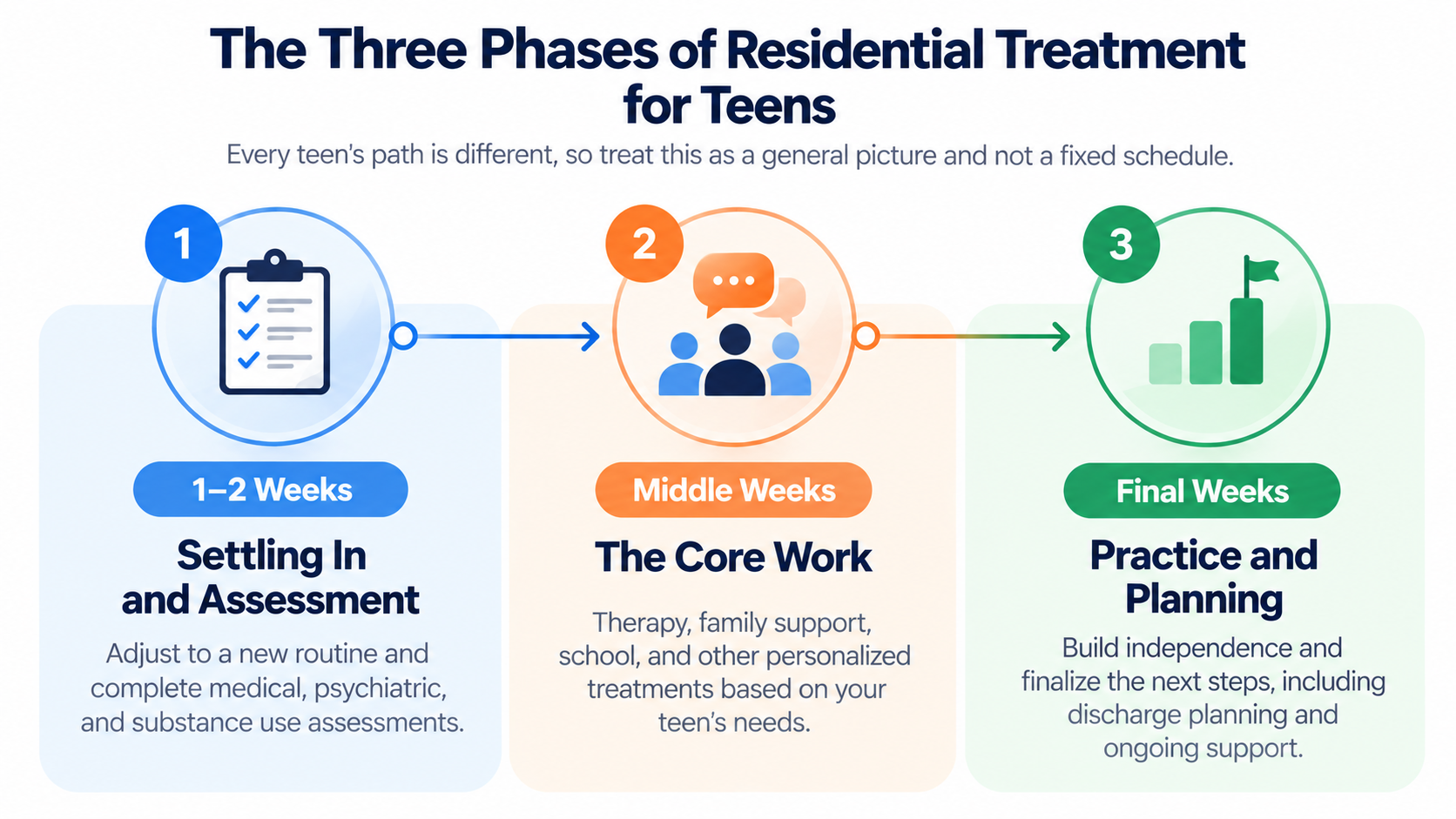
Every teen’s path is different, so treat this as a general picture and not a fixed schedule.
The first one to two weeks: settling in and assessment. Your teen adjusts to a new routine and gets to know staff and peers. The team completes medical, psychiatric, and substance use assessments. At Visions, a comprehensive psychological evaluation begins one or two weeks after admission, once a teen has started to acclimate.
The middle weeks: the core work. This is where most of the change happens. Depending on the teen’s needs, it may include:
- Individual therapy
- Group therapy with peers
- Family therapy
- Medication management when appropriate
- School, so your teen keeps up academically
- Experiential therapy, exercise, and nutrition
The final weeks: practice and planning. Your teen practices new skills with more independence, and the team finalizes the discharge plan with you: what level of care comes next, what school will look like, and what to do if things get hard.
If you are preparing for admission, our guide to what to bring to residential treatment covers the practical side.
Is a Longer Stay Always Better?
Not necessarily. The aim of residential care is to get a teen stable and skilled enough to continue healing in a less restrictive setting. Staying longer than needed keeps a teen away from family, friends, and school without adding benefit.
What research does support is enough total time in treatment. The National Institute on Drug Abuse, in its guide to adolescent substance use treatment, notes that “outcomes are better when a person stays in treatment for 3 months or more.” That refers to treatment overall, not to residential care alone. Time in a step-down program counts.
One study of 1,933 adolescents in residential substance use treatment in Australia found that stays of 60 to 89 days were linked to better outcomes, with no added benefit from 90 to 120 days. It is a single study from another health system, but it fits the general range.
How Insurance Affects Length of Stay
Insurers rarely approve a full stay up front. More often they authorize a number of days, then review clinical updates from the treatment team before approving more.
In California, state-regulated health plans must base these decisions on criteria developed by nonprofit professional associations, not on their own internal rules. State law requires it, and the regulator has named the tools: for mental health care for ages 6 to 17, the CALOCUS-CASII; for substance use, the ASAM Criteria.
Ask any program you are considering how authorization works with your plan and what happens if the insurer’s timeline and the clinical team’s recommendation differ.
What Comes After Residential Treatment
Discharge is a transition, not a finish line. Many teens continue in step-down care, which offers structure with more independence:
- Extended care. A longer transitional program for teens who need more time before returning home. At Visions, it has a minimum length of stay of 90 days.
- Intensive outpatient program. Several hours of therapy on multiple days a week while living at home.
- Therapeutic day school. Academics with therapeutic support built in.
- Outpatient therapy and family therapy.
Our parent’s guide to what happens after residential treatment walks through the first weeks at home.
Questions to Ask a Program About Length of Stay
- What is your average length of stay, and what is the range?
- How do you decide when a teen is ready for discharge?
- How often will we get updates on progress and timeline?
- When does discharge planning start?
- How does school work during treatment, and how do credits transfer?
- What step-down options do you offer or recommend?
- How do you handle insurance reviews during the stay?
How Visions Can Help
Visions has more than 20 years of experience treating adolescents, with residential programs in Malibu and Thousand Oaks. Our team builds each teen’s plan around their needs, keeps families involved throughout, and works with your teen’s school so they can continue their education during treatment.
After residential care, support continues through extended care, outpatient programs, day school, and our alumni program.
If you are trying to work out whether residential treatment is right for your teen and what the timeline might look like for your family, Visions can help you take the next step. Call (818) 889-3665 or contact us for a free assessment.
Frequently Asked Questions
Is 30 days of residential treatment enough for a teen?
For some teens, 30 days is enough to stabilize and step down to outpatient care. Many need longer. At Visions, stays average between six weeks and three months, depending on each teen’s needs and progress.
Will my teen fall behind in school during residential treatment?
They do not have to. Quality programs include school as part of the day. At Visions, our team works with your teen’s school and educators so they can continue their education throughout treatment.
Can a residential stay be extended?
Yes. If a teen needs more time, the treatment team will recommend it and explain why. Extended care is another option for teens who are ready to leave residential treatment but not ready to go home.
Can I take my teen out of residential treatment early?
Parents are part of every decision, and it is important to raise concerns with the treatment team. Leaving before the team recommends can increase the risk of setbacks, so talk through the plan for continuing care first.
How long is extended care for teens?
At Visions, extended care has a minimum length of stay of 90 days. It is designed to bridge the gap between residential treatment and a return to daily life.
Final Takeaway
How long residential treatment lasts matters less than what your teen leaves with. At Visions, a stay of six weeks to three months is typical, and the right length is the one that gets your teen stable, skilled, and supported for what comes next. Ask about the timeline early, stay involved, and plan for the transition from day one.
Sources
- American Academy of Child and Adolescent Psychiatry. Principles of Care for Treatment of Children and Adolescents with Mental Illnesses in Residential Treatment Centers. June 2010.
- National Institute on Drug Abuse. Principles of Adolescent Substance Use Disorder Treatment: A Research-Based Guide.
- Whitten T, et al. Drug and Alcohol Review. 2023. Summarized by the Recovery Research Institute.
- California Health and Safety Code section 1374.721.
- California Department of Managed Health Care. All Plan Letter 21-002.